
Have you ever wondered how those cool lamps turn on with just a tap? It feels like magic, right? We’re talking about touch bedside lamps. This article will explain how do touch bedside lamps work in a simple way.
These lamps are super handy. They make turning lights on and off easy. You just touch the base or stem. Let’s explore the science behind this everyday wonder.
The Core Principle: Capacitive Sensing Explained

The secret behind touch lamps is something called capacitive sensing. This fancy term just means the lamp can ‘feel’ your touch. It does this by noticing tiny changes in electricity.
What is Capacitive Sensing?
Think of a capacitor as a tiny battery. It can store a small electrical charge. Touch lamps use this idea. They create a small electrical field around their metal parts.
How Your Finger Completes a Circuit
Your body can conduct electricity. When you touch the lamp, you become part of its electrical field. This changes how the lamp ‘sees’ its own electricity. The lamp’s circuit detects this change.
“Capacitive sensing allows a device to detect the presence of a conductive object, like a human finger, without direct physical contact or pressure.”
Here’s a simple flow of how it works:
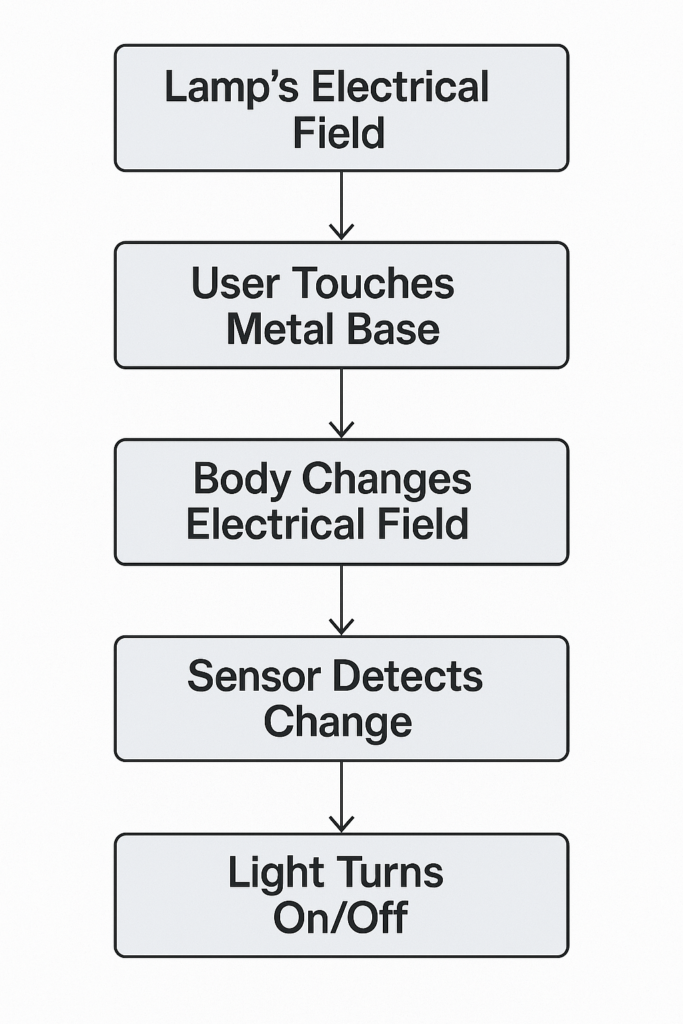
Components Inside a Touch Lamp: What Makes Them Tick

Every touch lamp has special parts working together. These parts make the touch feature possible. Understanding them helps us know how do touch bedside lamps work.
The Touch Sensor
This is the most important part. It’s usually a small chip or circuit. It’s connected to the metal parts of the lamp. This sensor constantly looks for changes in the electrical field.
Control Circuit Board
This is like the lamp’s brain. It takes the signal from the touch sensor. Then, it decides what to do. Should the light turn on, off, or get brighter? The circuit board makes that call.
The Light Bulb
Of course, a lamp needs a light bulb! Modern touch lamps often use LED bulbs. These are energy-efficient. They also work well with the dimming features.
Here’s a table of key components:
| Component | Role in Touch Lamp Operation |
|---|---|
| Touch Sensor | Detects changes in electrical field from touch |
| Control Circuit | Processes sensor data, sends commands to bulb |
| Power Supply | Provides electricity to all components |
| Light Bulb | Emits light based on control circuit’s command |
How the Touch Sensor Detects Your Touch

Let’s dive deeper into the sensor. This part is key to how do touch bedside lamps work. It’s all about tiny electrical signals.
Tiny Electrical Fields
The lamp’s metal casing is connected to the touch sensor. This setup creates a very small, harmless electrical field around the lamp. You can’t see or feel this field normally.
Changes in Capacitance
When your finger touches the metal, it adds a bit of its own capacitance to the circuit. This changes the lamp’s electrical field. The sensor is super sensitive. It notices this tiny change. It then sends a signal to the lamp’s brain, the control circuit.
The Brain of the Lamp: The Control Circuit

Once the touch sensor detects you, the control circuit takes over. This is where the magic really happens. It makes the lamp respond correctly.
Interpreting the Signal
The control circuit receives the signal from the touch sensor. It quickly figures out if it was a quick tap or a longer hold. It also counts how many times you’ve touched it.
Sending Commands to the Light
Based on your touch, the circuit sends a command. This command tells the light bulb what to do. Maybe it’s ‘turn on,’ ‘turn off,’ or ‘change brightness level.’ This rapid process shows the cleverness of how do touch bedside lamps work.
Dimming Magic: How Touch Lamps Adjust Brightness

Many touch lamps offer different brightness levels. This is a very popular feature. It’s another clever aspect of how do touch bedside lamps work.
Multiple Touch Levels
Most lamps use a sequence. A first touch might be dim. A second touch makes it medium. A third touch brings it to full brightness. The fourth touch turns it off. This cycle is controlled by the circuit board.
Pulse Width Modulation (PWM) Briefly
For smooth dimming, some advanced lamps use PWM. This quickly turns the light on and off. It does this so fast that your eyes don’t see it flicker. Instead, you just see a dimmer light. The longer the ‘on’ time, the brighter the light appears.
Types of Touch Bedside Lamps and Their Features

Not all touch lamps are the same. They come with different features. This adds to the convenience of how do touch bedside lamps work.
Single-Touch vs. Multi-Touch
Single-Touch: These lamps usually just turn on or off. They might have one brightness level.
Multi-Touch: These are more common. They offer several brightness settings. You tap to cycle through them.
USB Charging Ports and Other Extras
Many modern touch lamps include extra features. Some have USB ports. You can charge your phone right from the lamp. Others might have built-in clocks or even color-changing LEDs.
| Feature | Description |
|---|---|
| Dimmable | Adjusts brightness with multiple touches |
| USB Charging | Built-in port to charge phones or devices |
| Color Changing | LEDs can change to different colors |
| Memory Function | Remembers last brightness setting when turned on |
Troubleshooting Common Touch Lamp Issues

Even the best technology can have hiccups. Knowing how do touch bedside lamps work can help you fix small problems. Don’t worry, most issues are easy to solve.
Lamp Not Responding
Check the bulb: Make sure it’s screwed in tightly. A loose bulb can stop the touch function.
Power source: Is the lamp plugged in? Is the outlet working? Try a different outlet.
Clean the lamp: Dirt or grime on the metal base can interfere with the sensor. Wipe it clean.
Flickering Light
Bulb type: Ensure you’re using the right bulb. Some touch lamps need specific types, like incandescent or dimmable LEDs.
Loose connection: Check if the bulb is loose. Tighten it gently.
Here’s a quick checklist:
1. Is it plugged in?
2. Is the bulb tight?
3. Is the lamp clean?
4. Is it the correct bulb type?
“Most touch lamp issues stem from simple power or bulb problems, not a broken sensor.”
Conclusion: Understanding How Touch Bedside Lamps Work

So, how do touch bedside lamps work? It’s not magic, but clever engineering. They use capacitive sensing to detect your touch. This tells a smart control circuit what to do.
From turning on and off to dimming, it’s all thanks to tiny electrical changes. These lamps make our lives a bit easier. They are a great example of smart design. Now you know the science behind your convenient touch lamp!
Frequently Asked Questions
How do touch bedside lamps work?
Touch bedside lamps work by using capacitive sensing. The lamp creates a tiny electrical field. When you touch its metal part, your body changes this field. A sensor detects this change and tells the lamp’s control circuit to turn the light on, off, or dim it.
Can touch lamps dim the light?
Most touch lamps offer multiple brightness levels. You simply tap the lamp repeatedly to cycle through dim, medium, bright, and off settings. The internal control circuit manages these different light output commands.
Do touch lamps have other features besides touch control?
Yes, many modern touch lamps include extra features. Common additions are USB charging ports for phones, built-in clocks, or even color-changing LED options. These features add to their versatility.
What should I do if my touch lamp stops responding?
If your touch lamp stops working, first check if it’s plugged in. Then, ensure the light bulb is screwed in tightly and is the correct type. Sometimes, cleaning the metal base can help if dirt is interfering with the sensor.
Are touch bedside lamps safe to use?
Yes, touch lamps are generally safe. The electrical field they use is very small and harmless. They meet safety standards, just like other electrical appliances. Always follow the manufacturer’s instructions for use and bulb type.

I’m Emily Johnson, an affiliate marketer and blogger focused on lamps and lighting. I share honest reviews, simple buying guides, and practical tips. My goal is to help readers choose the right lamp for their space, style, and budget with confidence.