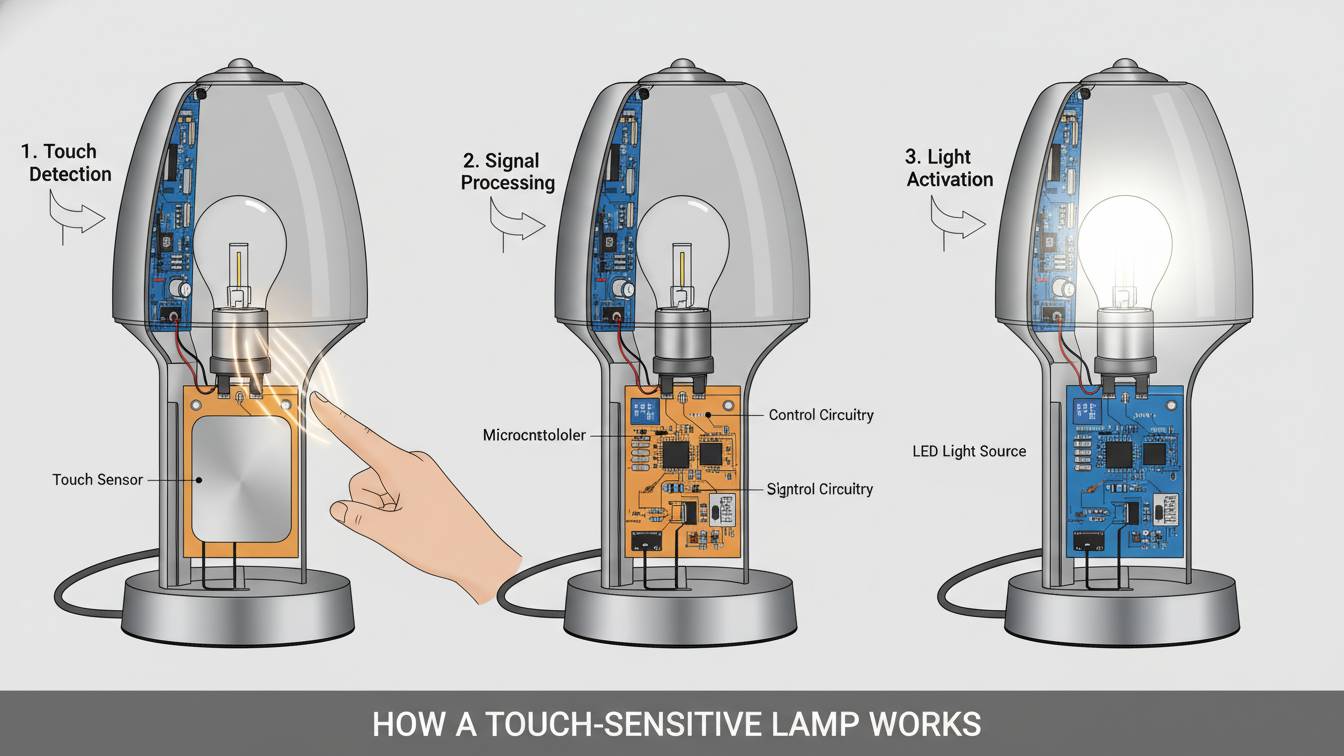
A touch-sensitive lamp works by detecting changes in capacitance when it is touched. When we make contact with the lamp, we alter its capacitance, causing the lamp to switch on or off accordingly.
This technology relies on the principle of body capacitance, utilizing human touch to activate the lamp instead of a physical switch. Unlike traditional lamps, touch-sensitive lamps do not require external switches and can be operated simply by a gentle touch from a finger.
This convenient and innovative feature makes touch-sensitive lamps a popular choice for modern lighting solutions.
Touch Sensitive Lamps Unveiled
Introducing touch-sensitive lamps that work by altering the lamp’s capacitance when touched, allowing it to switch on or off accordingly. These lamps detect changes in capacitance, making them a convenient and modern alternative to traditional switches. Discover how touch-sensitive lamps work and enjoy a seamless lighting experience with just a gentle touch.
Exploration Of Touch Sensitive Lamp Technology
Touch sensitive lamps, also known as touch lamps or touch-sensitive switches, have revolutionized the way we interact with lighting fixtures. These innovative lamps utilize advanced technology that allows users to control the light simply by touching the lamp’s surface. In this section, we will delve into the inner workings of touch sensitive lamps and how they operate.
Interaction With User Touch And Lamp Response
When we touch a touch sensitive lamp, we actually alter its capacitance. Capacitance is the ability of a component to store an electric charge. In the case of touch sensitive lamps, the lamp detects this change in capacitance and responds accordingly. This means that by touching the lamp, we can turn it on or off, adjust the brightness, or even change the color, depending on the specific features of the lamp.
The interaction between the user’s touch and the lamp’s response is made possible by the integration of capacitive touch sensing technology. Capacitive touch sensing works by creating an electric field on the surface of the lamp. When a user touches the lamp, the lamp’s capacitance changes due to the conductive properties of the human body.
This change in capacitance is then detected and translated into a signal by the lamp’s built-in touch sensing circuitry. The circuitry, often comprising of sensors and microcontrollers, interprets the touch signal and triggers the corresponding actions, such as turning the lamp on or off. This seamless interaction between the user and the lamp’s touch sensing technology allows for a convenient and intuitive control over the lighting.
The Subtle Science Enabling Touch Sensitivity
The touch sensitivity of these lamps may seem like magic, but it is actually a result of scientific principles. The concept of body capacitance plays a key role in enabling touch sensitivity in lamps. Body capacitance refers to the capacitance exhibited by the human body, which varies depending on factors such as moisture and surface area of contact.
When a person touches a touch sensitive lamp, their body becomes an extension of the lamp’s electrical circuit. This small current flows from the conductive layer through the person’s finger, creating a path for the electrical charge. The lamp’s circuitry detects this current and reacts accordingly, allowing for touch-based control over the lamp’s functions.
This intricate interplay between the lamp’s capacitive touch sensing technology and the user’s touch enables the lamps to respond instantaneously and accurately to touch-based inputs. It is this elegant blend of science and technology that makes touch sensitive lamps not only a practical lighting solution but also a fascinating piece of engineering.
How Touch Sensitive Lamps Work
When it comes to touch sensitive lamps, understanding how they work may seem like a mystery to some. However, the basic principles behind touch detection, the role of capacitive sensing, and the electrical physics at play can help shed light on this fascinating technology.
Basic Principles Behind Touch Detection
Touch detection in lamps relies on the concept of capacitance. Capacitors, which store varying amounts of charge, are used in circuits to tune devices like radio receivers or smooth out voltage fluctuations. When we make contact with a touch lamp, our touch alters its capacitance, which is detected by the lamp’s circuitry. This change in capacitance triggers the lamp to switch on or off accordingly, providing a touch-responsive interface.
Role Of Capacitive Sensing In Operation
Capacitive sensing plays a crucial role in the operation of touch sensitive lamps. In these lamps, the concept of body capacitance is utilized. When a person touches the lamp, their body acts as a conductor, creating a small current that flows through the conductive layer and their finger. This current alters the capacitance of the lamp’s circuit, which is then detected by its capacitive sensing mechanism. This mechanism effectively senses the change in capacitance caused by the touch, signaling the lamp to turn on or off.
The Electrical Physics At Play
Understanding the electrical physics behind touch sensitive lamps further reveals how they work. When a person touches the lamp, there is an exchange of electrons between their body and the lamp itself. This exchange causes a difference in the number of electrons between the two, which is detected by the lamp’s circuit as a change in capacitance. By monitoring this capacitance change, the lamp’s circuitry can accurately sense the touch and activate the corresponding switch, enabling the lamp to function as a touch-sensitive device.
In conclusion, touch sensitive lamps operate by utilizing the basic principles of capacitance and capacitive sensing. When a person touches the lamp, it alters the capacitance of the circuit, triggering the lamp to switch on or off. Understanding the underlying electrical physics at play can help demystify how these innovative lamps provide a touch-activated lighting experience for users.
Anatomy Of A Touch Lamp
A touch-sensitive lamp works by altering its capacitance when it comes into contact with a person’s touch. This change in capacitance is detected by the lamp, causing it to switch on or off accordingly. This technology eliminates the need for physical switches, providing a convenient and modern lighting solution.
Key Components Making Up Touch Lamps
A touch-sensitive lamp consists of several key components that work together to provide its unique functionality:
- Tactile Sensor: The tactile sensor is the primary component that detects touch and triggers the lamp. It is usually integrated into the lamp’s base or body.
- Control Unit: The control unit serves as the brain of the touch lamp. It receives signals from the tactile sensor and processes them to determine whether the lamp should be switched on or off.
- Light Source: The light source is the bulb or LED that emits light when the touch lamp is activated. It can be a variety of light sources, including incandescent, fluorescent, or LED.
- Power Supply: The power supply provides the necessary electrical current to operate the touch lamp. It can be a battery pack or directly connected to an electrical outlet.
Material Specifics That Enable Touch Sensitivity
The touch sensitivity of a touch lamp relies on the specific materials used in its construction. These materials enable the lamp to detect changes in capacitance:
- Conductive Layer: The conductive layer is usually located beneath the lamp’s surface and is made of a conductive material such as metal or a conductive coating. It facilitates the transfer of electrical charge when touched.
- Insulating Layer: The insulating layer separates the conductive layer from other components in the touch lamp. It ensures that the electrical charge is directed only to the desired circuitry.
Capacitors And Their Function In Touch Lamps
Capacitors play a crucial role in the operation of touch lamps, as they store and release electrical charge. Here’s how capacitors function in touch lamps:
- Capacitive Circuit: Touch lamps utilize capacitive circuits, which consist of one or more capacitors connected in a specific configuration.
- Capacitance Change Detection: When a person touches the lamp, their body alters the capacitance of the capacitive circuit. This change in capacitance is detected by the control unit, indicating that the lamp should be turned on or off.
- Charge Transfer: The capacitors in the touch lamp facilitate the transfer of charge between the conductive layer and the control unit, enabling the detection of touch.

Credit: www.cnbc.com
User Interaction And Lamp Behavior
A touch-sensitive lamp works by detecting changes in capacitance when we make contact with it. Capacitors in the lamp store charge, and when we touch the lamp, the capacitance is altered, causing the lamp to turn on or off accordingly.
It’s a simple way to control the lamp’s behavior through user interaction.
How Human Touch Changes Lamp Behavior
When you make contact with a touch-sensitive lamp, you alter its capacitance, which is the ability to store electrical charge. Capacitors in the lamp’s circuitry store varying amounts of charge, and by touching the lamp, you introduce a change in capacitance.
The Process From Touch To Light Toggle
When the touch-sensitive lamp detects the altered capacitance, it triggers a switch to turn the lamp on or off accordingly. This seamless transition from touch to light toggle happens due to the lamp’s ability to sense the changes in capacitance and respond instantly.
Safety Measures In Lamp Design
The design of touch-sensitive lamps incorporates safety measures to ensure user protection. By using body capacitance, these lamps eliminate the need for physical switches, reducing the risk of potential electrical hazards.
Moreover, these lamps typically operate on low voltage to further enhance safety. This voltage is not strong enough to cause any harm to the user upon contact but is sufficient to detect capacitance changes and trigger the lamp’s response.
In addition, touch-sensitive lamps undergo rigorous testing and meet stringent safety standards to ensure their reliability and user-friendliness. Manufacturers implement insulation measures and grounding techniques to prevent electrical mishaps and ensure user safety.
Overall, touch-sensitive lamps offer a convenient and safe way to control lighting with a simple touch of the hand, making them a popular choice for modern lighting solutions.
The Fascinating Science Behind It
In the realm of touch-sensitive lamps, the science behind their operation is truly remarkable. At first glance, these lamps may seem like ordinary light fixtures, but they actually incorporate innovative technology that allows them to be controlled with a simple touch. Understanding the comprehensive science behind touch-sensitive lamps can help illuminate the magic of their functionality.
The Comprehensive Science Of Capacitive Touch
Touch-sensitive lamps operate on the principle of capacitive touch. Capacitors, electronic components that store electrical charge, play a crucial role in the functioning of these lamps. Capacitors are commonly used in circuits to tune their performance or regulate voltage fluctuations.
In the case of touch lamps, when we make contact with them, we alter their capacitance. This change in capacitance is detected by the lamp, triggering it to switch on or off accordingly. It’s truly an impressive example of how electrical principles can be harnessed to create convenient and interactive lighting solutions.
Innovations And Improvements In Touch Lamp Technology
Over the years, touch lamp technology has undergone significant advancements, leading to improved functionality and user experience. Manufacturers have developed touch-sensitive circuits capable of accurately detecting variations in capacitance caused by human touch. By fine-tuning these circuits, touch lamps have become more responsive and reliable.
Additionally, advancements in materials and manufacturing techniques have led to the development of sleeker and more aesthetically pleasing touch-sensitive lamps. These continuous innovations ensure that touch lamps remain at the forefront of modern lighting solutions.
Touch Lamps’ Place In Modern Home Automation
Touch-sensitive lamps are not just standalone light fixtures; they also have a significant role to play in modern home automation. With the rise of smart homes, touch lamps have seamlessly integrated into these systems, providing a convenient and intuitive way to control lighting.
By connecting touch lamps to home automation hubs or voice assistants, users can effortlessly adjust lighting levels or create customized scenes with just a touch or a voice command. This integration enhances the overall ambiance and convenience of the home environment, making touch lamps an essential component of modern households.
Frequently Asked Questions Of How Does A Touch Sensitive Lamp Work
How Do Touch Sensitive Buttons Work?
Touch sensitive buttons work by utilizing body capacitance. These buttons have a metal exterior that charges and discharges, detecting changes in capacitance. When a person touches the button, their body increases the capacitance and triggers the switch. This allows for easy and convenient control of various devices without the need for physical buttons or switches.
Why Don T They Make Touch Lamps Anymore?
They don’t make touch lamps anymore because they are not compatible with modern LED bulbs and other energy-efficient devices. People also prefer not to use incandescent bulbs anymore. Additionally, touch lamps require intricate microchip technology, making them less popular in the market.
How Do Touch Plant Lamps Work?
Touch plant lamps work using micro-chip technology. When you touch a leaf, the lamp detects the touch and switches on. Holding a leaf brightens or dims the light, and releasing it returns the light to its original state. The lamp is operated solely by touching the plant’s leaves, no additional switches are needed.
Do Touch Lamps Require A Special Bulb?
Touch lamps do not require a special bulb. They work by detecting changes in capacitance when a person touches the lamp. This alters the lamp’s capacitance and causes it to switch on or off accordingly.
https://www.youtube.com/watch?v=V3mriHLV3oo
Conclusion
Touch-sensitive lamps work by utilizing capacitors to store charge and adjust circuitry. When contact is made with the lamp, the capacitance is altered, signaling the lamp to turn on or off. These lamps operate based on body capacitance, activating with a gentle touch from a finger.
They have become a popular alternative to traditional physical switches. Touch-sensitive lamps are both convenient and efficient, providing a unique and modern lighting experience.

I’m Emily Johnson, an affiliate marketer and blogger focused on lamps and lighting. I share honest reviews, simple buying guides, and practical tips. My goal is to help readers choose the right lamp for their space, style, and budget with confidence.